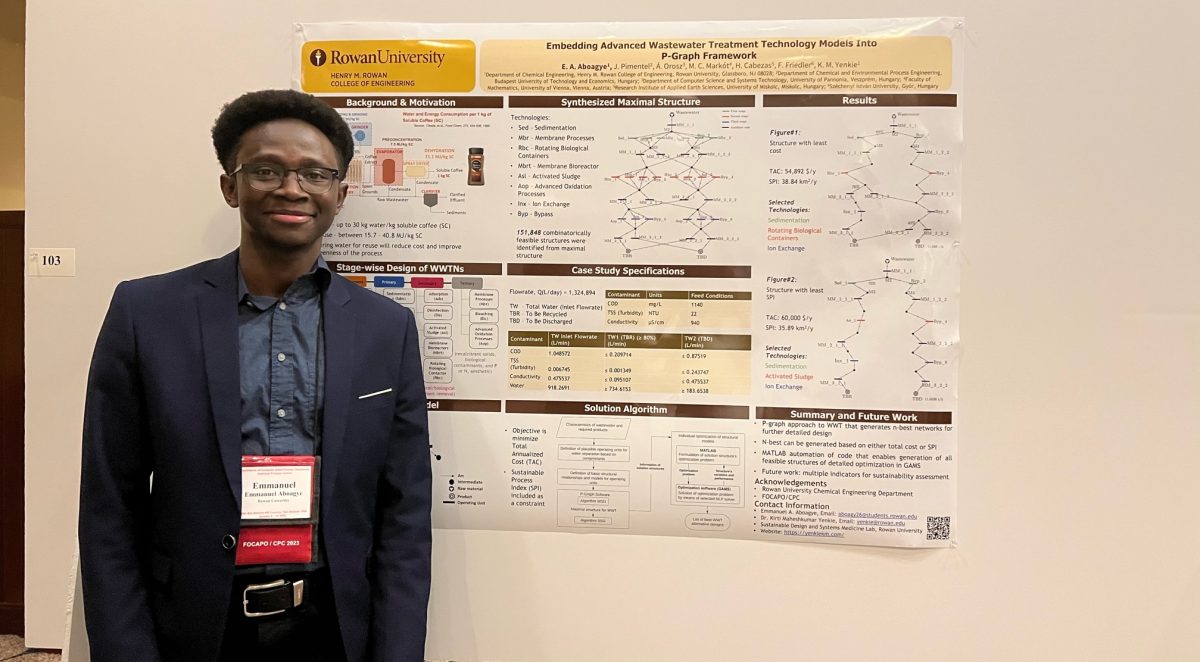
(i) Machine Learning for Sustainable Chemicals & Processes

This project intends to advance the state of knowledge in sustainable chemical design through the development of novel Machine Learning techniques. Currently, access to physical and chemical properties, separation mechanisms, environmental impacts, sustainability metrics, and the life cycle of novel chemicals can be very difficult since there is very little to no information available. However, these chemical properties as well as the environmental sustainability metrics are required for eco-friendly and safer substitutes. Integrating machine learning with process synthesis and modeling methods can assist in finding missing information for environmental and sustainability metrics.
Funding: US EPA Bipartisan Infrastructure Law (BIL) Pollution Prevention (P2) Grant for Computational Modeling and Machine Learning for Sustainable Processes and Chemicals (PI, 10/2022 – 09/2025, $314,416)
(ii) Design of Water Treatment, Asset Management & Resilience
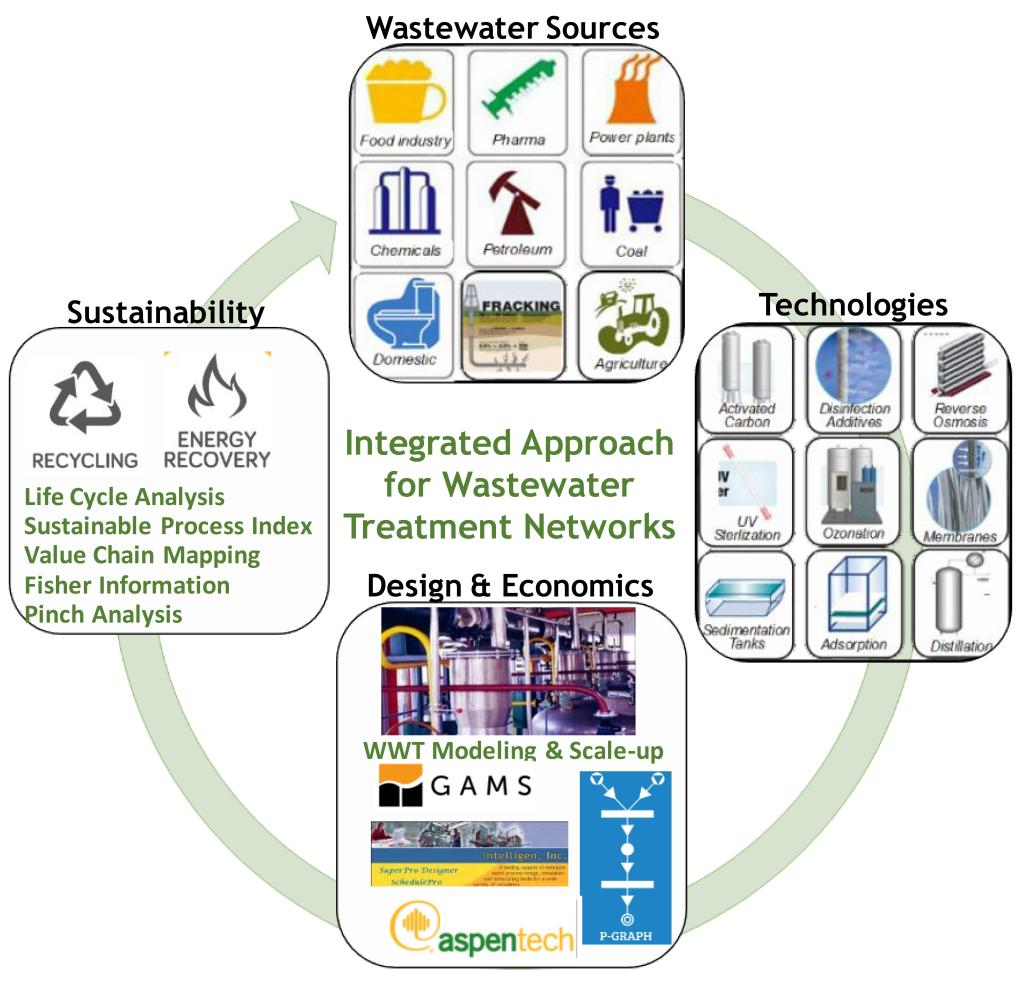
Development of a Wastewater treatment superstructure consisting of all possible treatment technologies and flows and optimizing the structure to predict technologies for meeting the purity requirements and low costs. We use representative case studies for municipal and pharmaceutical wastewater treatment and model them as optimization problems. In the next step, we use the Graph Theory for solving the same problems as it can provide insights into non-intuitive solutions, that guarantee global optimality.
Funding: NSF CAREER Award for Integrating Graph Theory with Machine Learning for Enhanced Process Synthesis and Design (PI, 07/2024 – 06/2029, $505,676), and Atlantic County Utilities Authority (ACUA), Atlantic City, NJ for Wastewater Grit Removal and Asset Management (Co-PI, 06/2020-06/2022, $64,511)
(iii) Optimizing Pipeline Flushing Operations in Lube Oil Packaging Plants

Lube oil blending plants must be well equipped to process thousands of unique compositions of lube oil products. One single pipeline network is used for packaging thousands of different products. These pipes have to be flushed by a finished product to clear the previous lube oil before packaging. This generates downgraded oil with low economic value. This makes the flushing operation highly cost-intensive and adds to a significant environmental burden. Thus, the main goal of this study is to minimize the amount of downgraded oil that is generated during flushing.
Funding: (i)US EPA Regional Pollution Prevention (P2) Grant for Roadmap for Efficient Transportation and Packaging Processes in Petroleum Pipelines (PI, 10/2022 – 09/2025, $361,816) (ii) US EPA Regional P2 Grant for Optimizing Pipeline Flushing and Lube Oil Blending Operations (PI, 10/2020 – 09/2023, $299,974)
(iv) Roadmap for Solvent Recovery in Industrial Manufacturing

As an alternative to conventional solvent disposal methods solvent recovery can improve the greenness and overall sustainability of processes in pharmaceutical and fine chemical industries. A superstructure approach was applied to develop the framework for solvent recovery, which begins with material (waste stream) input, followed by the process technologies that have capability to perform desired separation, reaction, or mixing. The systematic framework developed in this study can be applied to existing and future chemical process designs to minimize solvent waste.
Funding: US EPA P2 Grant for Developing a Solvent Recovery Roadmap (PI, 10/2018-09/2021, $289,111)
(v) Optimizing Resin Selection for Ion Exchange Processes
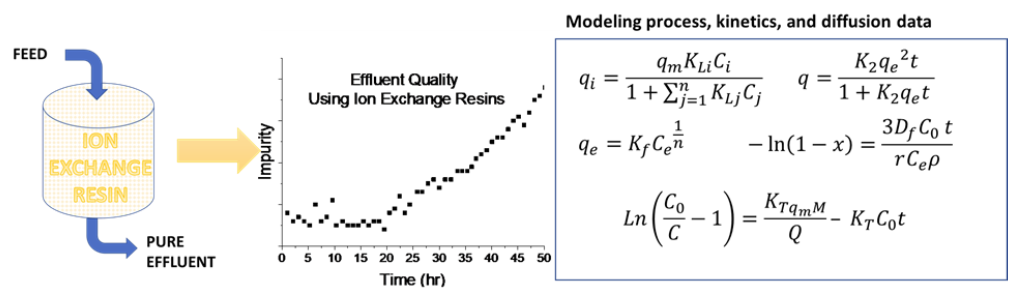
Ion exchange resins are widely used in the industry to purify water and recover some valuable compounds. Most of these resins are polymeric based beads that are characterized by various parameters such as particle size, pore diameter, functional groups, and polymeric matrices that play an important role in a successful purification process. This project will concentrate on identifying working models that identify such direct relationship between process performance and the key resin parameters.
(vi) Computer-Aided Perovskite Solar Cell Synthesis

Structurally, perovskites have the stoichiometry ABX3, where A and B are cations and X is an anion. To determine the formability of perovskites, two important factors (octahedral and tolerance) described by Goldschmidt play a vital role in structural stability. We propose an integrated methodology that can select optimum combination of ions for the perovskite solar cell synthesis and simultaneously minimize the material cost.
(vii) Cancer Therapeutics
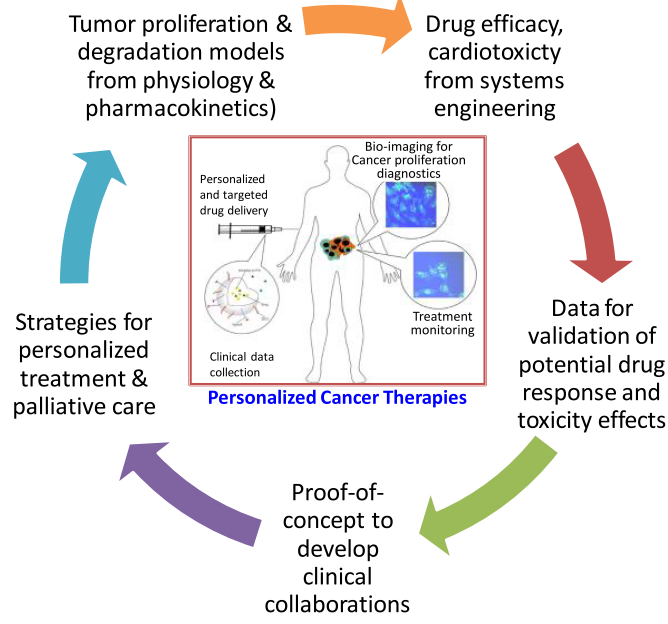
We intent to develop customized treatment schedules for cancer patients using mathematical modeling, optimization and machine learning tools. Neural networks, decision trees, support vector machines were to determine biological markers linked to Leukemia subtype identification. This information is necessary for determining which tests to conduct for effective for diagnosis and associated treatment scheduled.
Funding: Rowan Seed Fund, Division of University Research
(viii) Management of IBS (Irritable Bowel Syndrome)

IBS is a chronic disease which has a multifactorial etiology, correlating these factors to understand the exact cause and determine the most suitable treatment or patient management strategy is of high importance. Systems engineering tools can be of help in the systematic analysis of IBS symptoms, cause-effect and treatment responsiveness in patients.
Funding: Inspira Health Hack Grant for IBS (Irritable Bowel Syndrome) management tool (Co-PI, 02/2019-01/2020, $20,000)
Additional Collaborative Projects and Funding:
NJ DEP (Department of Environmental Protection) Grant for Investigating methods to utilize the byproducts of biodigester waste (Co-PI, 01/2024 – 12/2025, $269,877)
NJ American Water Grant for Optimizing Drinking Water Treatment (Co-PI, 09/2023 – 08/2026, $231,304)
Industry Sponsored Engineering Clinic Project from ExxonMobil Paulsboro Lubricants Oil Blending Plant, New Jersey (PI, 09/2019-08/2021, $64,500)
KEEN (Kern Entrepreneurship Education Network) & Rowan ExEED (Experiential Engineering) Curricular Reimagination Grant for Integrating Design Thinking in pedagogy (PI, 07/2019-06/2020, $2500)
 Yenkie Research Group